
Atlanta, Georgia | April 27, 2026
Story by Joëlle Walls and Photos by James-Addis Hill
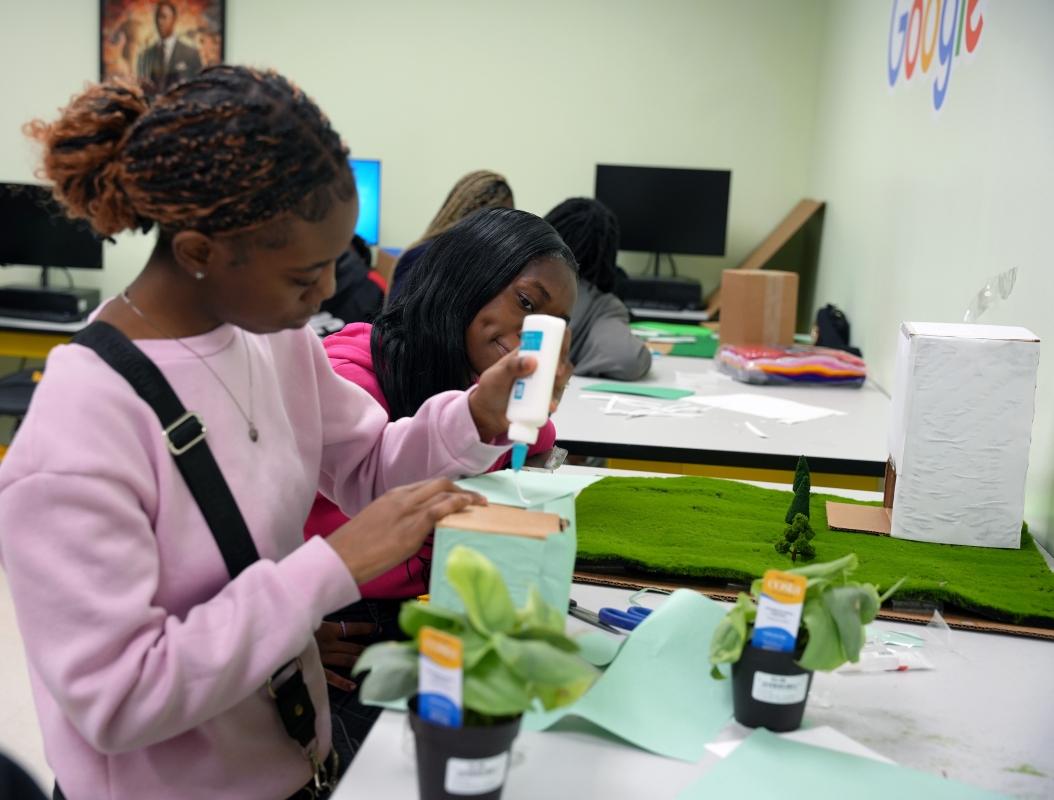 Tenth graders at Benjamin Mays High School do not have to look any further than outside their building to study the concept of urban heat islands and how they affect their local community. Since fall 2025, students have been working in teams to identify hot spots across the city. Using data from Arduino sensor technology, they are designing solutions to help mitigate fluctuating temperatures, influenced by streets, sidewalks, and minimal green spaces due to urbanization.
“It was so relevant to our students, all being from the city of Atlanta and being able to clearly make that connection to what the city feels and looks like versus maybe being on the outskirts, like in a suburban area,” said environmental science teacher Roshae Jackson. “They live in these urban areas. They know what it feels like. They can tell you.”
This project is the latest hands-on learning experience being piloted at the school’s technology hub, the result of a collaboration between Google and the Center for Education Integrating Science, Mathematics, and Computing (CEISMC) within Georgia Tech’s College of Lifetime Learning.
Foundational to this immersive STEM experience is an intentionally designed curriculum to guide students through a full learning cycle. That same cycle began last summer when Marchan Jackson, a technology and computer science teacher at Lindley Middle School, participated in CEISMC’s Georgia Immersive Fellowships for Teachers (GIFT) program.
Jackson co-developed the curriculum, “The Urban Oven: What’s Firing Up Our Cities?” alongside Shameka Williams, program director on CEISMC’s School and Community Engagement team. The curriculum is grounded in the 5E instructional framework, design thinking, and the engineering design process to guide the inquiry-based project.
“Instead of just asking more questions, the curriculum is designed to help students think through the process by giving them resources to research and develop their own problems and solutions,” Marchan Jackson explained.
A key component of the GIFT program is that participants take their lesson plans and implement them in their own classrooms during the following school year. Jackson has done so with her seventh graders and noted that initial confusion on the topic turned into deeper engagement.
“They were just looking at me like, ‘What are you talking about?’” Jackson explained. “Once they understood what urban heat islands were, they were able to start researching and coming up with solutions.”
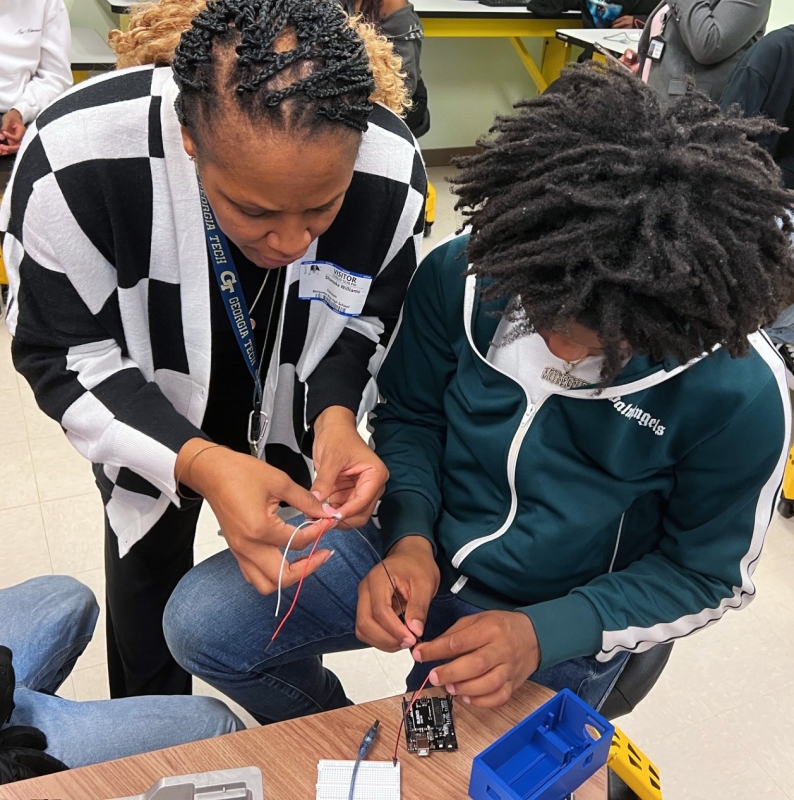 As Jackson’s GIFT mentor, Williams (pictured on the right) brought her experience as a science educator and PBL coach to the curriculum design process, with a focus on real-world relevance and student access.
“I wanted to make sure we weren’t just developing a curriculum, but creating something every student could access in a way that allows them to thrive,” Williams said. “It gives them space to understand that there are problems, but they are just as capable as anyone else of creating solutions to problems that impact them.”
That design is now taking shape in Roshae Jackson’s classroom. On select days, Williams and Norman “Storm” Robinson III, CEISMC’s associate director for school and community engagement, joined Jackson to support students during technology-focused lessons. Students are developing and coding environmental monitoring systems to test their ideas, including exploring alternatives to heat-absorbing building materials and adding more greenery.
“I like how this project was constructed to not give students the answers immediately, but to really have them think through it,” Jackson said. “When students realize they can figure things out on their own, that’s when the learning really sticks.”
